
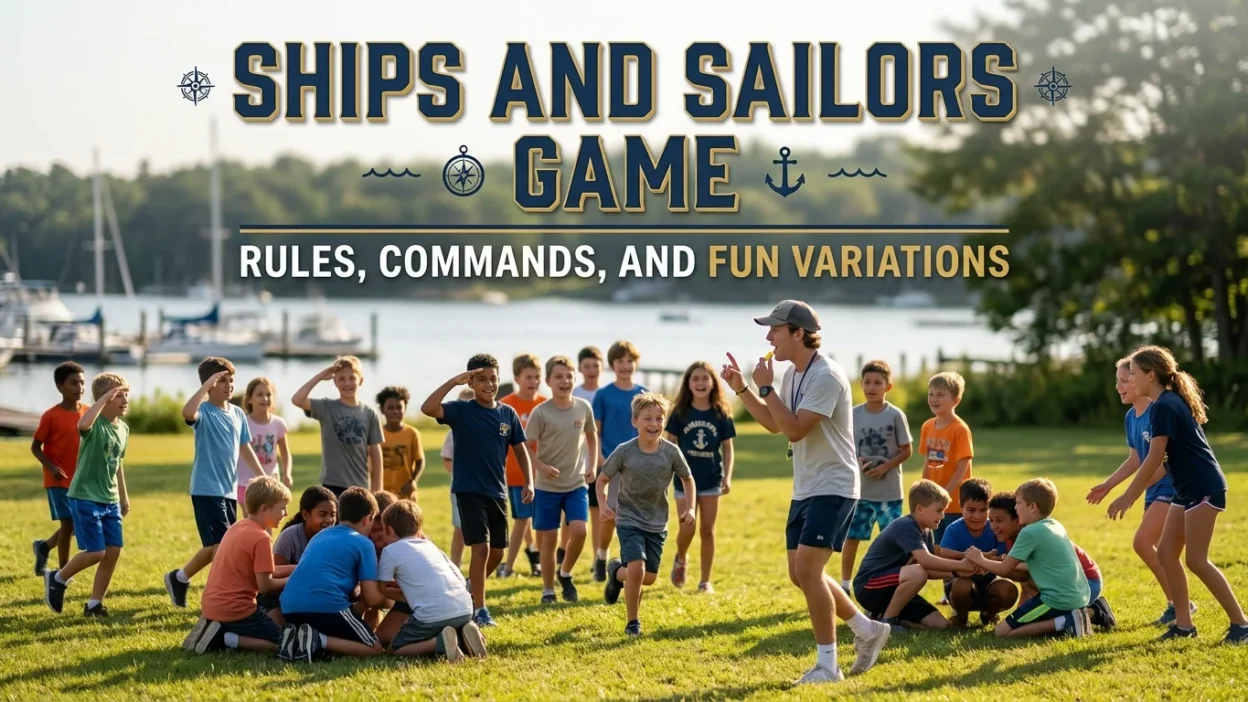
The Ships and Sailors game is an exciting group activity that tests listening skills, quick reactions, and teamwork. Inspired by life at sea, this fast-moving game asks players to follow a captain’s commands, move to different sides of the playing area, and perform funny actions before time runs out.
It works well for school classrooms, summer camps, birthday parties, youth groups, and team-building events. Best of all, you do not need expensive equipment or complicated preparation. A captain, a group of players, and enough open space are usually all you need.
Whether you are organizing a game for young children or planning a lively activity for teenagers and adults, you can easily adjust the rules to suit your group. Below, you will find simple instructions, popular commands, creative variations, and practical tips to make the Ships and Sailors game more enjoyable for everyone.
What Is the Ships and Sailors Game? ⚓
Ships and Sailors is a captain-led group game in which players listen to instructions and perform the correct actions as quickly as possible. The caller acts as the captain, while everyone else becomes part of the crew.
The game shares some similarities with Simon Says because both activities reward attention and quick reactions. However, Ships and Sailors adds nautical commands, directional movement, and entertaining group challenges.
Different schools, camps, and activity leaders may use slightly different rules. Therefore, it is important to explain what each command means before the first round begins.
The game is especially useful for:
- Classroom movement breaks and physical education sessions.
- Summer camps and youth group activities.
- Birthday parties and family gatherings.
- Icebreakers for new groups.
- Team-building sessions that encourage cooperation.
- Indoor and outdoor recreational events.
Its flexibility makes it suitable for both small gatherings and larger groups.
How to Play the Ships and Sailors Game 🎮
Getting started is simple. First, choose a captain, explain the commands, and establish clear boundaries. Then let the captain call instructions while the rest of the crew tries to respond correctly.
What You Need to Play 🧭
You only need a few basic things to organize the activity:
- A captain who calls out instructions.
- Several players who act as sailors.
- A clear area where everyone can move safely.
- Enough room to form small groups when necessary.
- Optional cones or floor markers to identify different sides.
You can play without any equipment. However, floor markers can make the game easier for younger children who need clear visual directions.
Basic Rules of the Game 📋
Follow these steps to organize a successful round.
- Ask everyone to spread out within the playing area.
- Choose one person to serve as the captain.
- Explain each command and demonstrate unfamiliar actions.
- Begin with simple instructions so players can learn the rules.
- Increase the speed once everyone understands the commands.
- Decide how to handle mistakes before starting.
- Continue until one player wins or the group finishes the planned rounds.
For a competitive version, players who perform the wrong action can leave the round. Alternatively, use a non-elimination format in which everyone stays involved.
The second option works particularly well for classrooms and children’s parties because nobody has to sit out for long.
Common Ships and Sailors Game Commands 🚢
The commands are the heart of the game. Each instruction tells players to move, freeze, form a group, or pretend to perform an action.
The following commands offer a practical starting point. Since rules vary between groups, choose the actions you want to use and explain them clearly.
- Ships — Run or walk to the designated side of the playing area.
- Sailors — Move to the opposite side.
- Captain’s Coming — Stand straight and salute the captain.
- At Ease — Relax and resume moving after a Captain’s Coming command.
- Hit the Deck — Carefully lower yourself toward the floor.
- Man Overboard — Find a partner and pretend to search for someone who has fallen overboard.
- Row Your Boat — Sit or crouch safely and imitate rowing.
- Swab the Deck — Pretend to clean the floor.
- Lookout — Make binoculars with your hands and scan the horizon.
- Shark Attack — Crouch down and make a playful shark-fin gesture.
- Seasick — Pretend to feel dizzy while remaining safely in place.
- Walk the Plank — Walk along an imaginary narrow plank without pushing anyone.
Remember that not every group uses the same commands. For example, some captains use “Port” and “Starboard” for left and right, while others keep the game focused on basic directional movements.
Funny Ships and Sailors Game Commands 😂
Funny commands can turn an ordinary round into a memorable group activity. They work especially well at birthday parties, summer camps, and youth events where the goal is to encourage laughter rather than strict competition.
Try adding these creative instructions:
- Pirate Pose — Stand like a pirate and deliver your best imaginary sea-captain expression.
- Fish Out of Water — Wiggle your arms and legs while sitting or lying safely on the floor.
- Sea Monster — Make a silly monster face and raise your arms.
- Captain’s Laugh — Laugh like a cartoon pirate.
- Dolphin Jump — Perform a small, controlled jump or raise both arms like a leaping dolphin.
- Storm Warning — Bend your knees slightly and pretend to balance on a rocking ship.
- Treasure Hunt — Pretend to search the ground for hidden treasure.
- Sleeping Sailor — Freeze in a comfortable sleeping pose.
- Parrot Alert — Place your hands near your shoulders and imitate a parrot.
- Telescope Time — Look through an imaginary telescope for land.
- Pirate Dance — Perform a short, silly dance before returning to your position.
- Mermaid Pose — Sit or stand in a balanced pose and imitate a mermaid.
These actions give the captain more ways to surprise the crew. However, introduce only a few new commands at a time so players can remember what to do.
Ships and Sailors Game Commands for Groups 🤝
Group commands add a teamwork element to the game. Instead of responding individually, players must find partners or form groups before the captain gives the next instruction.
They are particularly useful when the group already understands the basic rules.
- Two Sailors — Find one partner and stand together.
- Three-Person Crew — Form a group of three and salute.
- Lifeboat — Gather in a small group and pretend to climb into a boat.
- Rowing Team — Find a few teammates and imitate rowing in rhythm.
- Treasure Crew — Form a group and pretend to carry a heavy treasure chest.
- Ship’s Photograph — Gather in a group and strike a cheerful sailor pose.
- Deck Cleaning Team — Work in pairs and imitate sweeping the deck.
- Rescue Mission — Form a small group and pretend to help a sailor.
- Crew Meeting — Gather in a circle and listen for the next command.
- Captain’s Helpers — Choose a few players to stand beside the captain.
Before using group commands, explain whether players must form exact-sized groups. You should also decide what happens to anyone who cannot find a group in time.
For younger players, allow everyone to participate even when they do not form a group quickly. This keeps the activity friendly and prevents unnecessary frustration.
Ships and Sailors Game for Kids 🧒
Children can enjoy this game because it combines movement, imagination, and simple listening challenges. Teachers can use it during physical education, classroom breaks, or group activities when children need a chance to move around.
For younger children, start with three or four commands. Demonstrate each action and give everyone enough time to respond before increasing the pace.
A beginner-friendly set includes:
- Ships — Move to one side.
- Sailors — Move to the opposite side.
- Captain’s Coming — Stand straight and salute.
- At Ease — Relax and move again.
- Lookout — Pretend to search for land.
- Swab the Deck — Pretend to sweep the floor.
Once children understand these instructions, add one or two funny commands. You can also invite a child to become the captain so everyone gets a chance to lead.
Avoid making elimination the main focus. Instead, let children try again after a mistake or complete a fun action before returning to the game.
Ships and Sailors Game for Teens and Adults 🎯
Older players may prefer a faster, more competitive version. Add memory challenges, unexpected command sequences, and team-based scoring to keep the activity interesting.
Here are a few ways to increase the difficulty:
- Rapid-Fire Round — Call familiar commands quickly, allowing only a short response time.
- Memory Round — Ask players to remember and perform a sequence of two or three commands.
- Captain’s Trick — Alternate between similar commands to test concentration.
- Team Challenge — Divide the group into teams and award points for correct responses.
- Last Crew Standing — Remove players who make mistakes until one winner remains.
- Silent Captain — Use agreed-upon hand signals instead of spoken commands.
- Reverse Round — Change the designated directions between rounds after explaining the new rules.
The reverse round is especially useful for testing attention. However, announce the rule change before beginning so the challenge remains fair.
For workplace events, consider team scoring instead of elimination. This approach encourages collaboration and gives everyone a reason to stay engaged.
Indoor and Outdoor Ships and Sailors Game Variations 🌳
You can play the game in different environments by adjusting the commands and movement requirements.
Indoor Version 🏫
A classroom, gym, or community hall can work well if the playing area is clear. Mark the boundaries with tape or cones, and replace running with brisk walking when space is limited.
Choose simple actions such as saluting, pretending to row, looking through an imaginary telescope, or mimicking a pirate. If desks and chairs occupy most of the room, keep players in their own spaces and use gestures instead of directional races.
Outdoor Version 🌞
An open playground, field, or spacious backyard allows more freedom of movement. Use cones to mark the sides of the ship and establish a clear starting area.
Outdoor games can include larger group formations and short races between designated points. Still, check the ground for hazards and leave enough room for players to stop without colliding.
Seated Version ♿
A seated version can help people participate when standing or running is uncomfortable or inaccessible.
Try commands such as:
- Captain’s Coming — Sit upright and salute.
- Row Your Boat — Make rowing movements with your arms.
- Lookout — Use your hands as imaginary binoculars.
- Pirate Pose — Strike a playful upper-body pose.
- Storm Warning — Move your upper body gently from side to side, if comfortable.
- Treasure Found — Pretend to open a treasure chest.
Adapt each action to the abilities and comfort of the participants. The aim is to make the activity enjoyable and accessible, not to require everyone to perform identical movements.
How to Make the Ships and Sailors Game More Exciting 🌟
A good captain knows how to keep players interested without making the rules unnecessarily complicated. Small adjustments can transform a simple activity into a lively group challenge.
- Start slowly — Give everyone time to learn the basic commands.
- Change the pace — Alternate slower instructions with quick sequences.
- Rotate captains — Let different players lead the game.
- Add creative actions — Introduce funny commands once the basics feel familiar.
- Use team points — Reward correct responses instead of eliminating players.
- Keep rounds short — End or reset a round before participants lose interest.
- Encourage everyone — Praise good teamwork, quick thinking, and creative performances.
- Set clear boundaries — Make sure everyone knows where they can move.
- Explain new rules — Introduce changes between rounds rather than unexpectedly.
You can also ask players to suggest their own nautical commands. This encourages creativity and gives the group a role in shaping the activity.
How to Choose the Best Rules for Your Group 📝
The best version depends on the age, size, and purpose of your group. A classroom activity may prioritize participation, while a party game may focus on laughter and competition.
Consider these factors before choosing your rules:
- Age — Younger children need fewer commands and more demonstrations.
- Group size — Larger groups benefit from clear boundaries and simple instructions.
- Space — Small rooms call for stationary actions, while open fields allow directional movement.
- Accessibility — Offer alternative movements so participants can join comfortably.
- Purpose — Use cooperative challenges for team-building and elimination rounds for friendly competition.
- Time — Choose a small set of commands for a short activity or add variations for a longer session.
You do not need dozens of commands to make the game successful. A few well-explained instructions and a confident captain can create a much better experience than a long list of confusing rules.
Frequently Asked Questions❓
How many players are needed for the Ships and Sailors game?
You can play with a small group of around five people, although larger groups often make the activity more energetic. For small groups, focus on simple commands rather than complicated team formations.
What is the main objective of the Ships and Sailors game?
The main objective is to listen to the captain and perform each command correctly. In competitive versions, players try to avoid mistakes and remain in the game until the final round.
Is Ships and Sailors similar to Simon Says?
Yes, both games involve listening carefully and responding to instructions. Ships and Sailors adds a nautical theme, directional movement, and group activities such as rowing or pretending to rescue a sailor.
What does Captain’s Coming mean in the game?
Players usually stand upright and salute when they hear “Captain’s Coming.” In many versions, they remain frozen until the captain says “At Ease.” Explain this rule before playing because variations exist.
Can you play Ships and Sailors without equipment?
Yes. You only need a caller, participants, and enough room to move safely. Optional cones or floor markers can help players identify boundaries and directions.
How do you make the game suitable for younger children?
Use a few easy commands, demonstrate the actions, and allow extra time for responses. A non-elimination format also helps children remain involved even when they make mistakes.
Can adults play the Ships and Sailors game?
Absolutely. Adults can enjoy faster rounds, memory challenges, team competitions, and funny commands. The game also works as a lighthearted icebreaker for meetings and group events.
How long should a game last?
A short round may take only a few minutes, while a longer session can include several rounds and rotating captains. Adjust the duration to the group’s attention span and energy level.
Conclusion 🏴☠️
The Ships and Sailors game is a simple, entertaining way to bring people together through movement, quick thinking, and teamwork. With a few basic commands, a clear playing area, and an enthusiastic captain, you can organize it for classrooms, parties, camps, and group events without special equipment.
Start with familiar instructions such as Ships, Sailors, and Captain’s Coming. Then introduce funny actions, team challenges, or faster rounds to keep everyone engaged. Most importantly, choose rules that suit your group, encourage participation, and make safety a priority. A little creativity can turn this easy nautical activity into a memorable experience for players of all ages.

Samuel Turner is a creative writer and naming enthusiast at NamzivoX. He enjoys creating unique, catchy, and memorable names for games, teams, groups, usernames, and more.